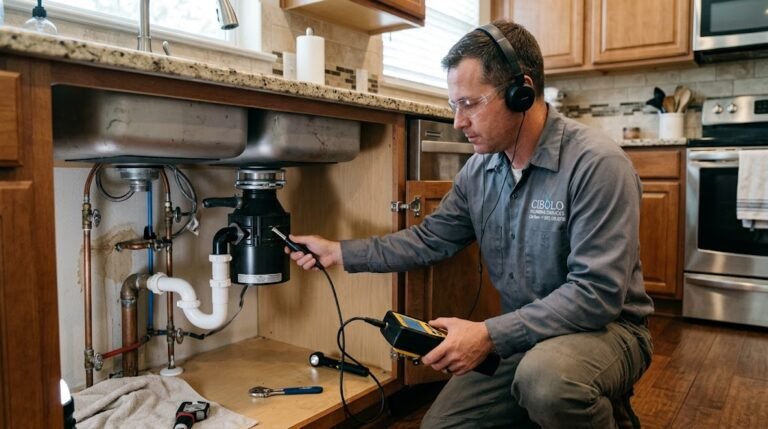
Kitchen Drain Help for Cibolo Homeowners
Slow Kitchen Sink Drain: Common Causes in Cibolo, TX
A kitchen sink that drains slowly is one of those small problems that gets worse the longer it is ignored. Water sits in the basin. Dishes pile up. Then one day the sink backs up completely, usually on a day when the kitchen is busy.
The cause is almost always something specific: grease, food debris, a clogged P-trap, a blocked vent, or a restriction further down the line. This guide explains what each one looks like, what you can safely check, and when the problem is beyond a home fix.
The Short Answer
A slow kitchen sink drain almost always comes down to one of five things: grease and food debris coating the inside of the pipe, a partial blockage in the P-trap, a blocked vent, a failing garbage disposal connection, or a restriction further down in the branch or main drain line.
If the sink drains slowly but does not back up:
- Grease and food particles are likely coating the pipe walls.
- The P-trap — the curved pipe under the sink that holds water and blocks sewer gas — may be partially clogged.
- The garbage disposal connection or the discharge tube may be restricted.
- The vent pipe may be blocked, which slows draining even without a full clog.
If water stands in the basin and does not drain at all:
- There is a full blockage, usually in the P-trap or the branch line.
- The disposal may be jammed or its outlet may be blocked.
- If other drains in the house are also slow, the main line may be involved.
The pattern matters: if the kitchen sink is the only slow drain, the problem is usually local. If more than one drain is slow, that is a signal to look further down the line.
Match the Symptom to the Likely Cause
The way the sink behaves tells you a lot about where the problem is. Use this table as a starting point before you start troubleshooting.
| What You Notice | Likely Cause | Suggested Next Step |
|---|---|---|
| Drains slowly but never backs up | Grease or food coating the pipe walls | Home maintenance; consider professional cleaning |
| Water stands in the basin and drains very slowly | Partial clog in the P-trap or branch line | Check the trap; if it does not clear, call a plumber |
| Gurgling sound when the sink drains | Blocked or improperly installed vent | Professional diagnosis |
| Both sides of a double sink are slow | Shared drain line or disposal discharge restriction | Check the disposal and common drain; may need professional help |
| Water backs up into the other basin | Blockage downstream of the shared trap | Professional drain cleaning |
| Sink and dishwasher both slow | Shared drain or disposal-related blockage | Check disposal connection; call if it persists |
| Multiple drains slow at the same time | Main line or sewer line issue | Sewer camera inspection recommended |
| Bad smell from the drain even when it flows | Dry trap, buildup, or vent issue | Clean the drain; if smell returns, professional look |
If your situation fits more than one of these patterns, the recurring drain clog guide covers what a repeated problem usually means. You can also review the plumbing services page for the service categories available.
Why Kitchen Sinks Slow Down
These are the reasons a kitchen sink drain most often becomes slow. Some are habits you can change. Others are physical problems in the pipe that need professional attention.
Grease and Cooking Oil
Grease is the most common cause of a slow kitchen drain. It goes down hot and liquid, then hardens as it cools. Each cooking session leaves another layer on the inside of the pipe. Over time the pipe narrows, and even small amounts of food start catching on the buildup.
Food Particles and Coffee Grounds
Rice, pasta, eggshells, coffee grounds, and starchy foods are common culprits. They do not dissolve in water the way people assume. Coffee grounds in particular act like sand in a drain — they settle, pack together, and catch everything else that flows past.
Clogged P-Trap
The P-trap is the curved section of pipe under the sink. The curve holds a small amount of water to block sewer gas, but it also catches debris. A partially blocked P-trap slows draining noticeably. This is one of the most common reasons a kitchen sink loses flow.
Garbage Disposal Issues
A disposal that is jammed, worn, or not grinding properly can leave food particles in the drain. Even a working disposal can struggle if it is overloaded with fibrous foods. The discharge tube on the disposal side is another common spot for buildup.
Blocked Vent Pipe
Every drain needs air behind it to flow properly. If the vent pipe that runs from the drain system up through the roof becomes blocked — by debris, a bird nest, or frost — the sink will drain slowly even without a clog. Gurgling and a slow drain with no visible blockage often point to venting.
Pipe Scale in Older Homes
Homes with older drain piping — especially cast iron — accumulate scale and corrosion on the inside of the pipe. That narrows the passage and gives debris a rough surface to catch on. A sink in an older home may drain more slowly than the same sink in a newer home simply because of the pipe interior.
Restriction Further Down the Line
When the kitchen sink shares a branch line with other fixtures, a blockage further down the line can slow the sink even though the P-trap itself is clear. This is why cleaning the trap sometimes does not fix the problem — the real obstruction is somewhere else.
Chemical Cleaner Residue
Repeated chemical drain cleaner use can leave behind a sludgy residue that continues to catch debris. In older pipes, the chemicals can also damage the interior surface, making future clogs more likely. If the sink only drains after chemical treatment, the underlying problem is still there.
Improper Slope or a Belly
A drain line needs a slight downward slope to carry water and debris away. If the pipe sags — a "belly" — water pools at the low point, and debris settles out of the flow. This is common in older homes and after ground movement. It can only be confirmed with a camera inspection.
When More Than One Drain Is Slow, Stop Running Water
If your kitchen sink is slow and another drain in the house is also slow — or if water backs up into the sink when other fixtures drain — the issue is likely in the main line rather than the sink trap. Continuing to run water pushes it toward the lowest point in the system. That is worth stopping and calling about.
What You Can Check Safely
These steps are low-risk and do not require special tools. If the problem involves more than one drain, or if you see standing water anywhere outside the sink basin, stop and call a plumber.
- ✓ Check whether only the kitchen sink is affectedIf other drains are fine, the issue is likely local. If several are slow, the main line may be involved.
- ✓ Look at the strainer and stopperFood debris and grease buildup at the opening can be wiped away. This is safe and often reveals the problem area.
- ✓ Run the garbage disposal brieflyIf the disposal sounds sluggish or jammed, that may be contributing. Never put your hand inside the disposal.
- ✓ Check under the sink for moistureWater around the P-trap or disposal fittings can mean a loose connection as well as a clog. Note anything wet.
- ✓ Try a plungerUse a cup plunger (the kind with a flat rubber cup) on the sink drain. Block the other basin or the dishwasher connection to get better suction.
- ✓ Review recent habitsGrease down the sink, coffee grounds, fibrous foods in the disposal, or wipes flushed in the house can all explain a slow drain.
Where to stop: do not remove the P-trap if you are not comfortable with plumbing work, do not pour multiple chemical drain cleaners down the sink, and do not force a stuck P-trap nut. If the plunger does not help or the problem returns quickly, the next step is a professional drain cleaning rather than more home remedies. For more on when clogs keep coming back, see the recurring drain clog article.
Signs the Problem Is Beyond a Home Fix
Some slow kitchen sinks clear with a plunger or a simple clean-out. Others need a professional because the actual problem is not in the trap. These are the situations where calling is the right next step.
- 1 A plunger no longer helps at all If plunging produces no movement, the blockage is likely too far down the line to reach from the sink. Continuing to plunge stresses the pipe joints and rarely fixes the problem.
- 2 The sink drains again briefly, then slows When a drain clears for a few days and then slows again, part of the blockage is still in the pipe. This is the pattern that points to a deeper restriction rather than a simple clog.
- 3 Water backs up into the other basin On a double sink, water rising in the second basin means the blockage is downstream of the shared trap. This is beyond what a home plunger can normally fix.
- 4 More than one drain in the house is slow If the kitchen sink and another fixture both drain slowly, the issue is likely in the branch or main line. A camera inspection is often the best way to confirm what is happening.
- 5 You hear gurgling from another fixture Gurgling from a tub or toilet when the kitchen sink drains often points to a venting issue rather than a simple clog. This usually needs a professional diagnosis.
- 6 The home has older drain piping Homes with cast iron or older drain lines tend to develop scale and corrosion. A professional look can determine whether cleaning, repair, or a more significant fix is appropriate.
- 7 Chemical cleaners have been used repeatedly If the sink only drains after chemical treatment, the pipe may have interior damage. A plumber can assess the actual condition and clear the blockage properly.
What Not to Do With a Slow Kitchen Sink
Home remedies have their place, but a few common reactions can turn a slow drain into a bigger problem. These are the ones to avoid.
Do Not Mix Chemical Cleaners
Different drain cleaners use different chemicals. Pouring one on top of another, or mixing them in the same drain, can create dangerous fumes or an unexpected reaction inside the pipe.
Do Not Force a Stuck Trap Nut
P-trap nuts on older sinks can seize up. Forcing one can crack the pipe or break the fitting, which turns a simple clog into a leak. If a nut will not turn by hand, stop.
Do Not Reach Into the Disposal
Even with the power off, the blades inside a garbage disposal are sharp. Never put your hand inside the chamber. Use tongs or a proper tool if you need to remove something.
Do Not Keep Running Water
If the sink is already backing up, running more water pushes it toward the lowest point in the system — which may not be the sink. Stop using the sink and any nearby fixture until the blockage is cleared.
Do Not Assume Grease Will "Flush Through"
Hot water does not remove grease from a drain. It moves it further along the pipe, where it cools and hardens again. That is how a small clog becomes a larger one further down the line.
Do Not Ignore a Persistent Odor
A kitchen drain that smells bad even when it flows can indicate buildup, a dry trap, or a vent issue. Masking the smell with air freshener does not fix the underlying problem.
Why Kitchen Drains Slow Down in Cibolo Homes
Kitchen drain problems in this area tend to follow a few familiar patterns. The water here carries dissolved minerals, and those minerals can deposit on the inside of pipes over time — especially on older drain lines. Homes with cast iron drain piping develop scale and roughness on the interior surface, which gives grease and food debris more places to catch.
The clay-heavy soil common in the area also expands and contracts with wet and dry cycles. That movement can shift buried drain lines and create low spots where debris settles. A sink that drains slowly in an older home is often showing the effect of both pipe condition and ground movement over the years.
None of this means every slow sink is a serious problem. Many clear up with a simple trap cleaning and better sink habits. But when the same sink keeps slowing down, the cause is usually in the pipe rather than in what is going down the drain. If you are weighing whether to keep troubleshooting or call someone, the guide on hiring a plumber in Cibolo covers how to vet a professional before you commit.
Cibolo, TX
Primary Service AreaDrain cleaning and local plumbing service for Cibolo homes and nearby properties.
View Service AreasSlow Kitchen Sink FAQs
Common questions from Cibolo homeowners dealing with a slow kitchen drain.
When only the kitchen sink is affected, the problem is local to that fixture's drain line. The most common causes are grease buildup, food particles in the P-trap, or a restriction in the short branch line that serves the sink. If other drains were also slow, the issue would be further down the system.
Hot water can move some grease along, but it does not remove grease from the inside of the pipe. What it often does is move the grease further down the line, where it cools and hardens again. This is one reason kitchen drains can develop clogs deeper in the branch line rather than right at the trap.
A small hand snake can sometimes clear a simple blockage in the trap or the pipe just past it, but there are risks. If the P-trap is plastic, aggressive snaking can damage it. If the blockage is further down the line, a hand snake rarely reaches it. If you have already tried a plunger without success, professional drain cleaning is usually the safer next step.
Gurgling usually means air is being pulled through the drain because the vent system is not working as it should. The vent pipe runs from the drain system up through the roof, and if it is blocked or improperly installed, drains will gurgle and slow down. This is a diagnostic item rather than a DIY fix.
No. Coffee grounds do not break down in water. They settle in the trap and the branch line, pack together, and catch other debris. Even with a garbage disposal, coffee grounds are best put in the trash or compost. The same applies to eggshells, rice, and pasta.
A slow sink is usually the first warning of a blockage that will eventually close the drain completely. If the underlying issue is in the branch or main line, ignoring it can lead to backups that affect other fixtures. Catching it while the sink is slow rather than after it has stopped draining is usually easier and cheaper.
Two signs point toward venting rather than a clog. First, gurgling from the sink or another fixture when water drains. Second, a sink that drains slowly but never fully blocks. If a plunger does nothing and there is no obvious buildup in the trap, venting is worth having checked. The only reliable way to confirm is a professional diagnosis.
You can send a request through the Contact Us page, or call (830) 590-5970. It helps to mention whether only the kitchen sink is affected, whether water backs up into the other basin, and whether the sink has been slow for a while or slowed down suddenly. You can also review the FAQs for more general plumbing questions, or read more on the plumbing blog.
Kitchen Sink Still Draining Slowly?
If a plunger did not clear it, or the sink keeps slowing down again, the problem is probably in the pipe rather than in the trap. A professional drain cleaning can clear the full blockage, and if the pattern suggests something deeper, a camera inspection can confirm what is actually happening in the line.
Explore Cibolo Plumbing Services
Additional pages that explain how this website and its services work.
Plumbing Services
Browse the main plumbing service categories available for Cibolo properties.
Why Does My Drain Keep Clogging?
What a repeated clog usually means, and when it points to a bigger issue.
Emergency Plumbing in Cibolo, TX
What to do when a pipe breaks, and how to respond before help arrives.
Hiring a Plumber in Cibolo, TX
Learn what to check before hiring a plumber — licensing, insurance, and estimates.
How Often Should Cibolo Homes Be Inspected?
Recommended inspection schedules based on home age and condition.
Contact Us
Submit a plumbing service request or contact us with a question.